Microelectronics | Apple Mac Pro 5,1
Synopsis
Some time ago, in fact, more than a decade, I was totally into Apple computers, and I really wanted the mid-2010 Apple Mac Pro 5,1. But the price was a total showstopper for me. And it remained so up until around 2016, when it dropped enough for me to think about an upgrade. But I chose the alternate path of building a PC from scratch instead of locking myself into the Apple ecosystem. And time proved that I chose wisely. Nevertheless, the 2010 to 2012 Mac Pro series remained one of my desires.
These days, old computers are, generally speaking, cheap because most of them are unusable for modern tasks. Or so we are led to believe, mostly due to inefficient software. I was able to find a mid-2010 Mac Pro 5,1 for nothing compared to what its listing price was. Thus, I bought it back in March 2025 and put it in storage. It was so filthy that I didn't bother to use it much, although I tested it. And... it felt really slow, probably due to the mechanical hard disk drives.
Disclaimer
This article is not to be treated as a do-it-yourself tutorial on how to fix, restore, rebuild, or improve this unit. This was not my initial intention. But you can consider this whole content as a general guideline, should you decide to attempt any service procedure on an identical or similar unit.
The entire documentation is just a reflection of my work and I cannot be held responsible if you damage your unit, or even harm yourself in the process.
Cleaning Everything
A few months have passed, and I found some time to work on the Mac Pro. First, I disassembled everything and washed every case-related part and electronic subassembly with soapy water. Disassembly was technically (very) easy, but the middle drawer was really difficult to remove due to tight clearances and the complicated latching mechanism. Also, the fans were difficult to remove because I didn't want to damage the rubber parts. I spent a few minutes carefully removing the optical drive bay and power supply fan without severing the rubber shock absorbers at all. In the end, the operation was successful.
Next, I washed the bare empty aluminum case in the bathtub with a soft brush and a lot of soapy water. After soaking most of the water out of the clean case, I blew the remaining water with compressed air, and then I let it in the summer sun for a couple of hours. And the results are as follows.
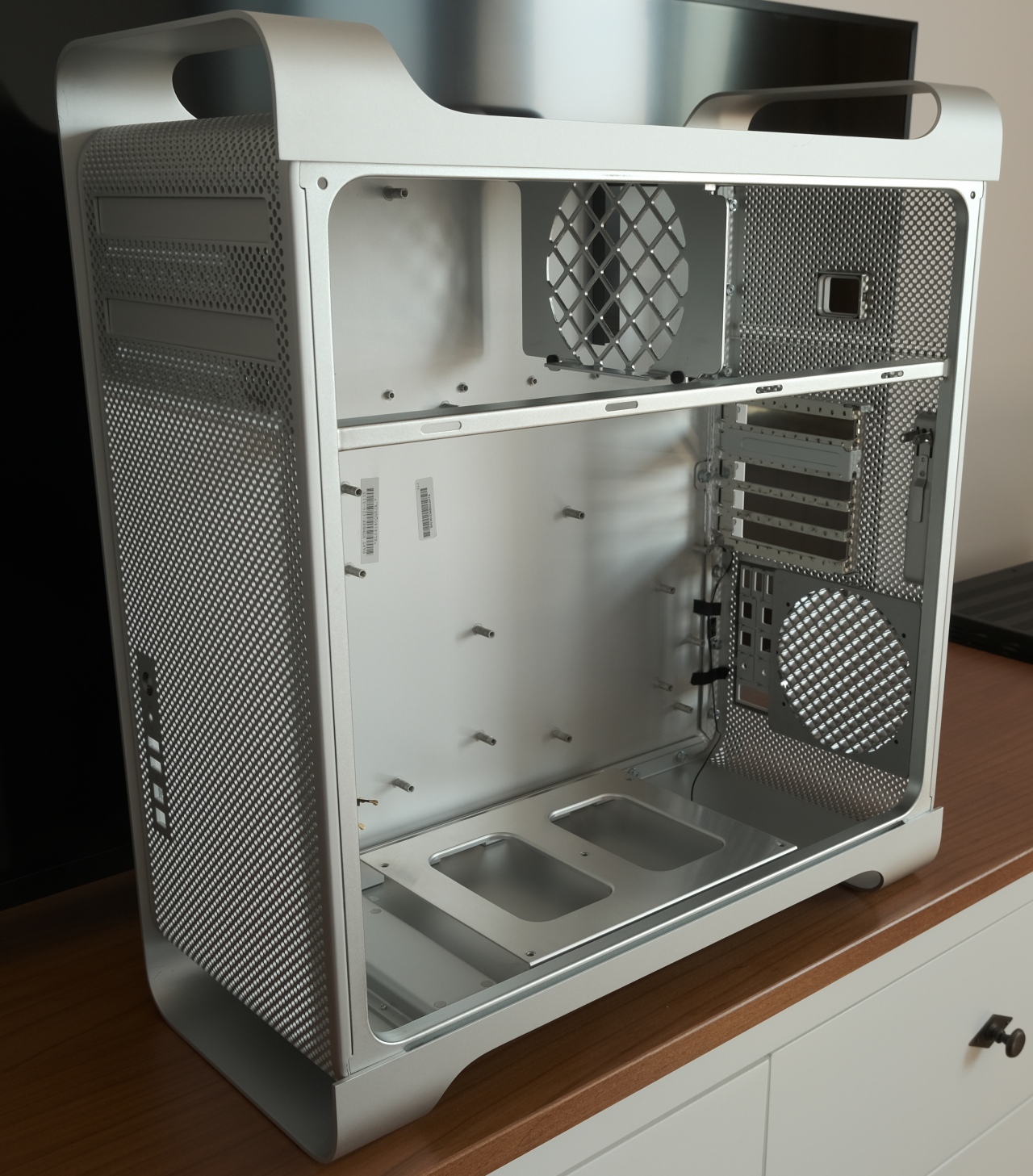
I installed the middle shelf, and managed to slightly scratch the sliding latch mechanism. Fortunately it's not visible, once everything is reinstalled.
The next operation was to wash the logic board (i.e.: mainboard in Apple slang). It had a thick layer of sticky dust, entirely covering the areas next to the fans. Initially, I tried to blow the dust off with compressed air, and a fine brush, but to no avail; it was so sticky that it quickly clogged the brush. After washing, I blew the water with compressed air and then I let it cook in the hot summer sun for the rest of the day. Finally, I installed the logic board back in the case.

There is a small PCB assembly on the front side of the case, exposing some communication ports and an audio interface. I had to wash this one as well. As the amount of sticky dust was insane, I also had to wash all the connection cables.
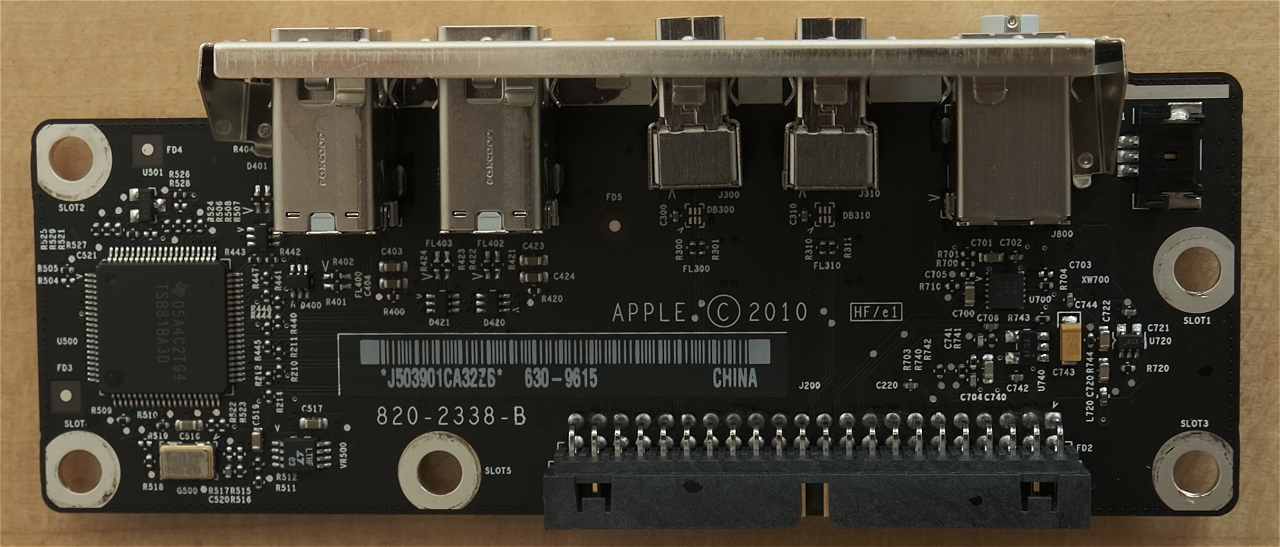
After reinstalling it in position, I connected the logic board to the PCB assembly via the proprietary connection cable.
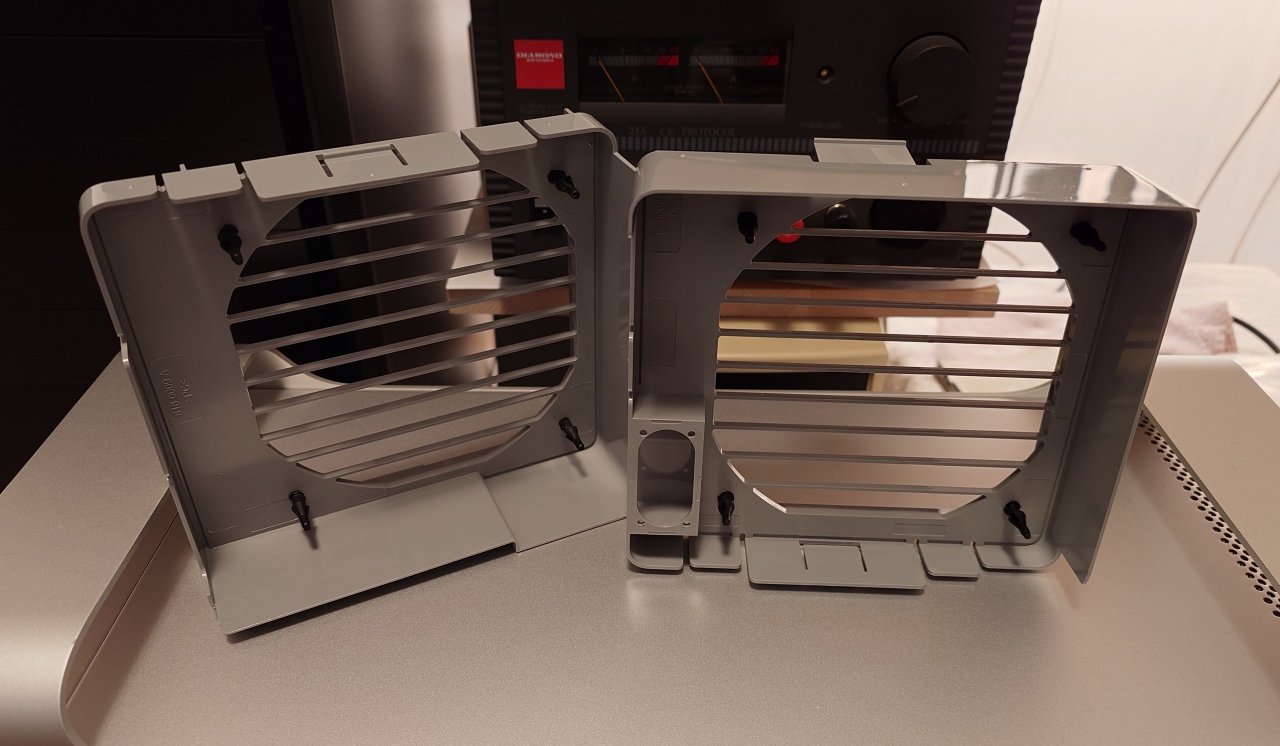
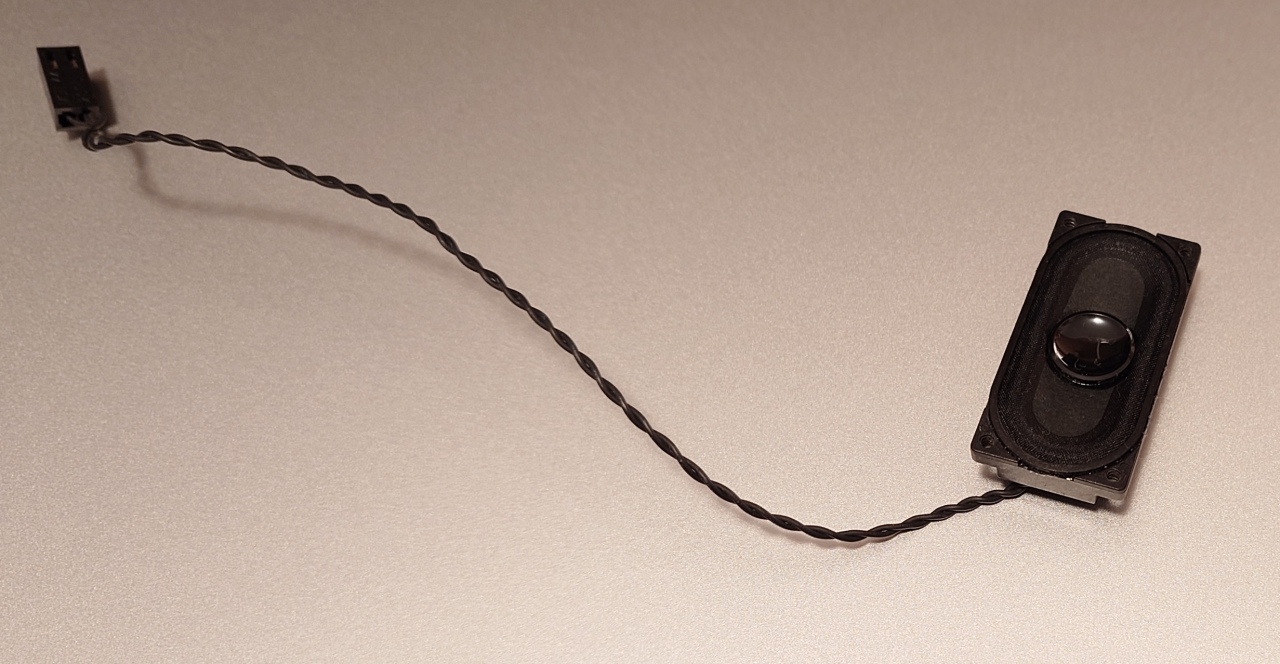
I also disassembled the CPU tray wind tunnel. I carefully removed both fans and their plastic holders. First, I carefully cleaned the fans and the small speaker, and then I washed everything else in the bathtub.
The speaker is located in an unfortunate position, next to a powerful fan that sucks air through the front grille. Thus, it unwillingly catches a fair amount of dust.
Moving on to the power supply reveals it is very well constructed. All internal components are of good quality. The lack of an internal fan forced the designers to rely on an external fan. It's interesting that it is controlled by the logic board, and not an internal power supply-related circuit.
Anyway, the amount of dust in the power supply reminded me of my first computer. It worked for at least ten years in a relatively dusty environment with a consistent amount of cigarette smoke. I was uneducated into computer maintenance, and it accumulated so much dust that when I opened the power supply for the first time (out of curiosity to see what was inside), a few very large dust bunnies dropped on my desk. And they were gross, almost like a sticky, dusty foam! If I recall correctly, that was back in 1998 or so.
Eventually, I washed the power supply PCB assembly together with the aluminum case in the bath tub, with soapy water.
...
I have to admit that I really do like the overall build quality and the attention to detail. It's obvious that they thought about even the smallest aspects of this design.
...
Your Help Matters
This content is provided as-is and is not for commercial purposes. It reflects my experiments and research and should be treated as such. I release my work to the public for educational purposes. I did all this at my own expense and in my free time. So if you like my work, or find it useful or inspiring for your projects, please consider making a donation.
Copyright © 2004- Alexandru Groza
All rights reserved.
VER. 1.0 | REV. A