Microelectronics | ASUS RT-N16 Wireless Router
Synopsis
A bulged capacitor on the low voltage regulator output load rail. This sounds like trouble. Reduction of production costs via shitty parts is a known practice. But then again, only three years of service? I have decided to replace all the electrolytic capacitors in this unit. I have chosen very high quality capacitors with a 10,000-hours rated life.
I will also change the ugly blue LEDs with amber counterparts. This operation is fairly easy to do, and it will be my first SMD LED soldering experience.
Finally, internal heat management can be improved.
Disclaimer
This article is not to be treated as a do-it-yourself tutorial on how to fix, restore, rebuild, or improve this unit. This was not my initial intention. But you can consider this whole content as a general guideline, should you decide to attempt any service procedure on an identical or similar unit.
The entire documentation is just a reflection of my work and I cannot be held responsible if you damage your unit, or even harm yourself in the process.
Pictures
Here are some pictures that I took during this operation.
Capacitor Replacement (2018)
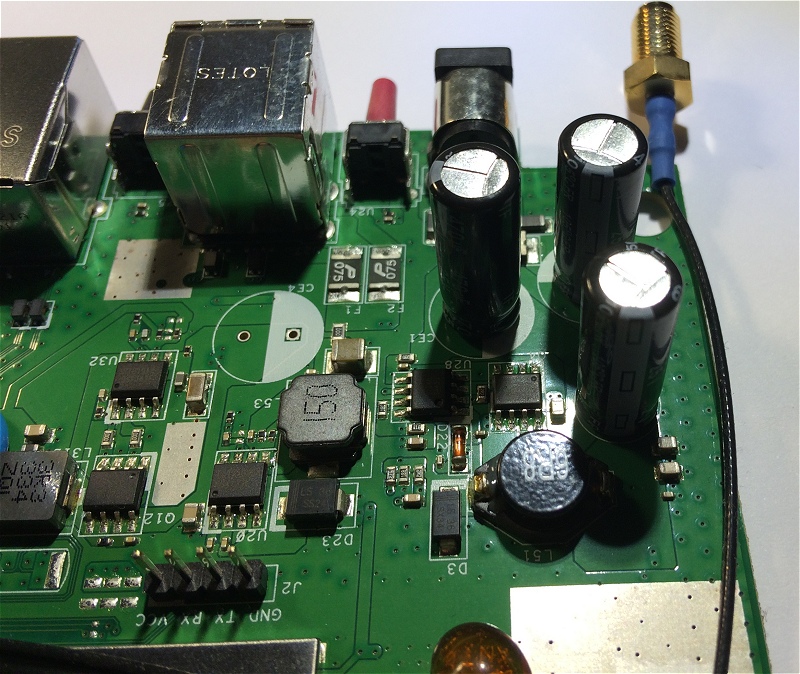
The blue capacitor is a Nichicon BT series part, while the black ones are Panasonic low ESR parts.

Working on this printed circuit board is a challenge if you don't have the right tools. The ground planes are very large. On the other hand, the thickness of the copper deposit is unexpectedly high. This is both a good (copper helps heat dissipation) and a bad sign (a powerful soldering iron is required).
So, I pumped 390 degrees Celsius into the soldering iron and I removed the old parts. Here are the junk capacitors.

The violet capacitor vented and leaked.

And here is the board after servicing. The new parts are good to go for several years. The blue capacitor is rated 125 degrees Celsius while the black ones are rated 105 degrees. The temperature inside the unit is unusually high, but it is nowhere near 60 degrees. Maybe during a hot summer it will rise even more? Anyway, I am thinking about buying some radiators to install on the various chips in this router. Maybe I can tame the heat a little bit. But this is another project.

There is a missing capacitor in position C34. I suspect it would be used for additional power supply ripple filtering, but I don't know why they didn't include it -- maybe for cost-cutting reasons.

The new Panasonic capacitors are taller and thinner than the old ones. The correct diameter capacitors were out of stock, so I picked what I found.
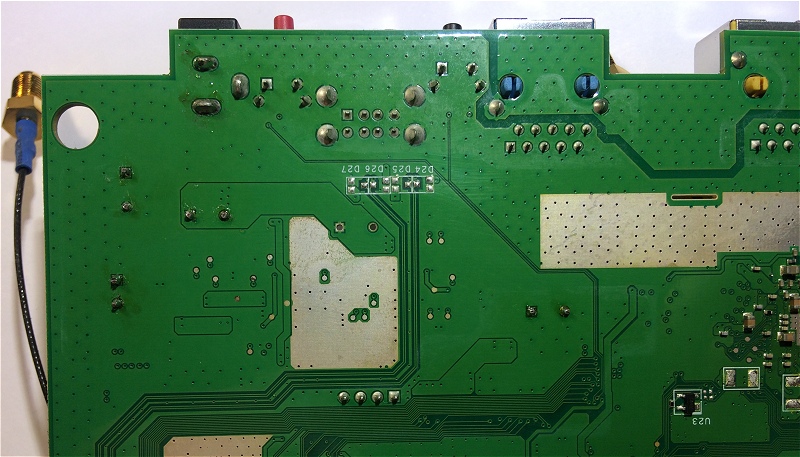
A view from the solder side.
LED Replacement (2019)
Blue LEDs, lit for the last time.

Interestingly enough, there is another row of pads for other LEDs. The current limiting resistors are missing. Maybe I will investigate this second row at some point.

I removed the first blue LED and cleaned the pads. This amber LED chip is ready to be soldered. I cannot but observe the maze-like pattern for the memory address and data lines spanning from the CPU. This approach is necessary so that signal propagation delays are all consistent.
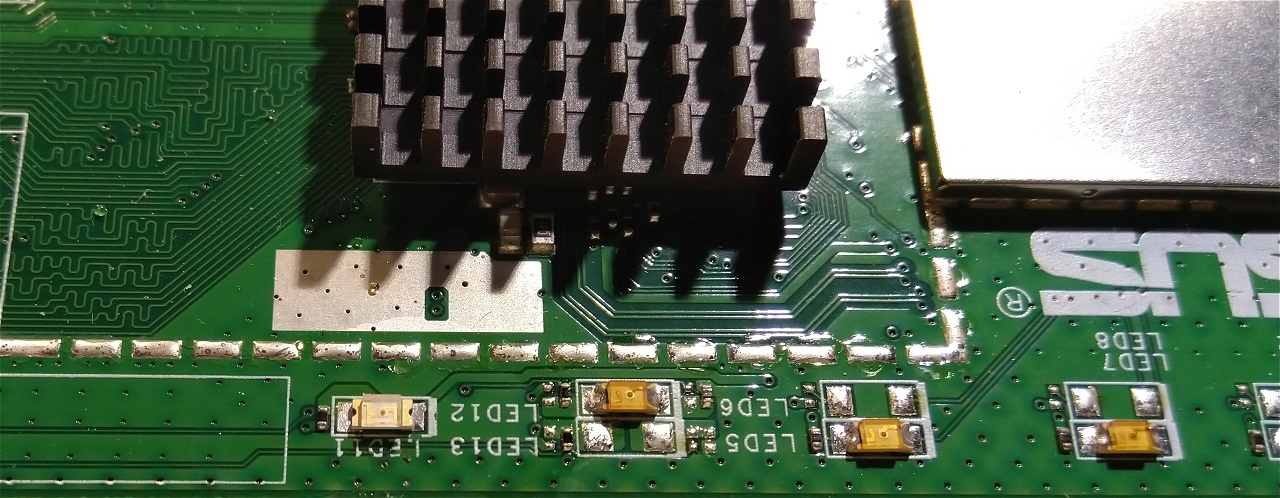
All new LEDs are soldered.
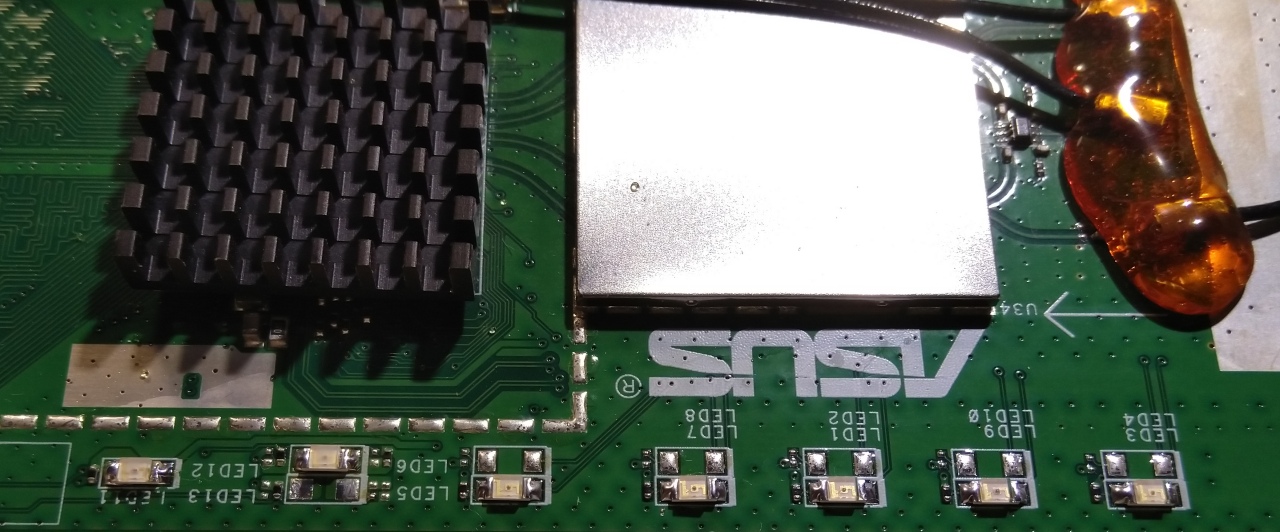
And lit for the first time.

I like it better now, and I find it less intruding during the nighttime.
Improving Heat Management (2023)
The original CPU heat sink is, more or less, a bad joke. I carefully removed it with a combination of a titanium razor blade, some dental floss, and enough acetone.

Next, I added some heat sinks to the CPU, Ethernet controller, RAM, and the RF chip. Well, the former is not exactly a chip but a complex circuit consisting of four chips and some additional components, all under an RF shield. But the RF shield does heat up, nonetheless.
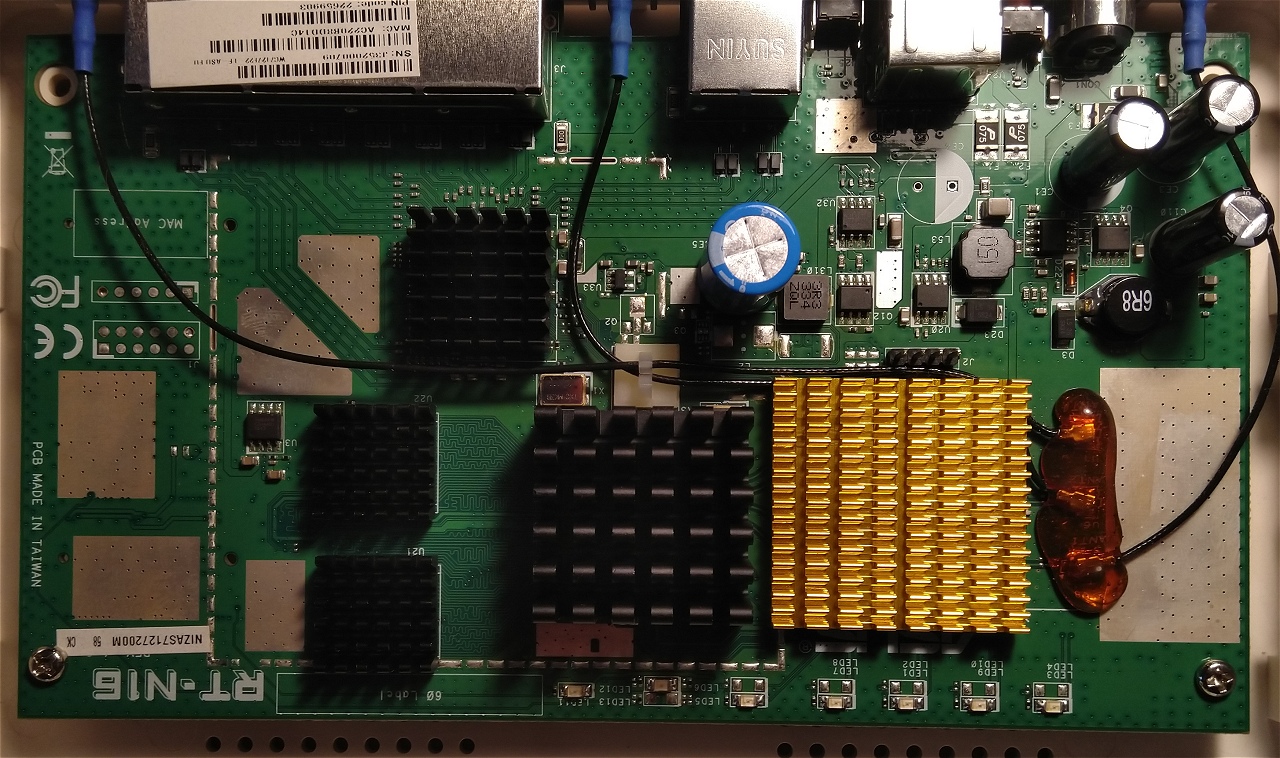
Here they are, viewed from a different angle. The CPU heat sink is the tallest.
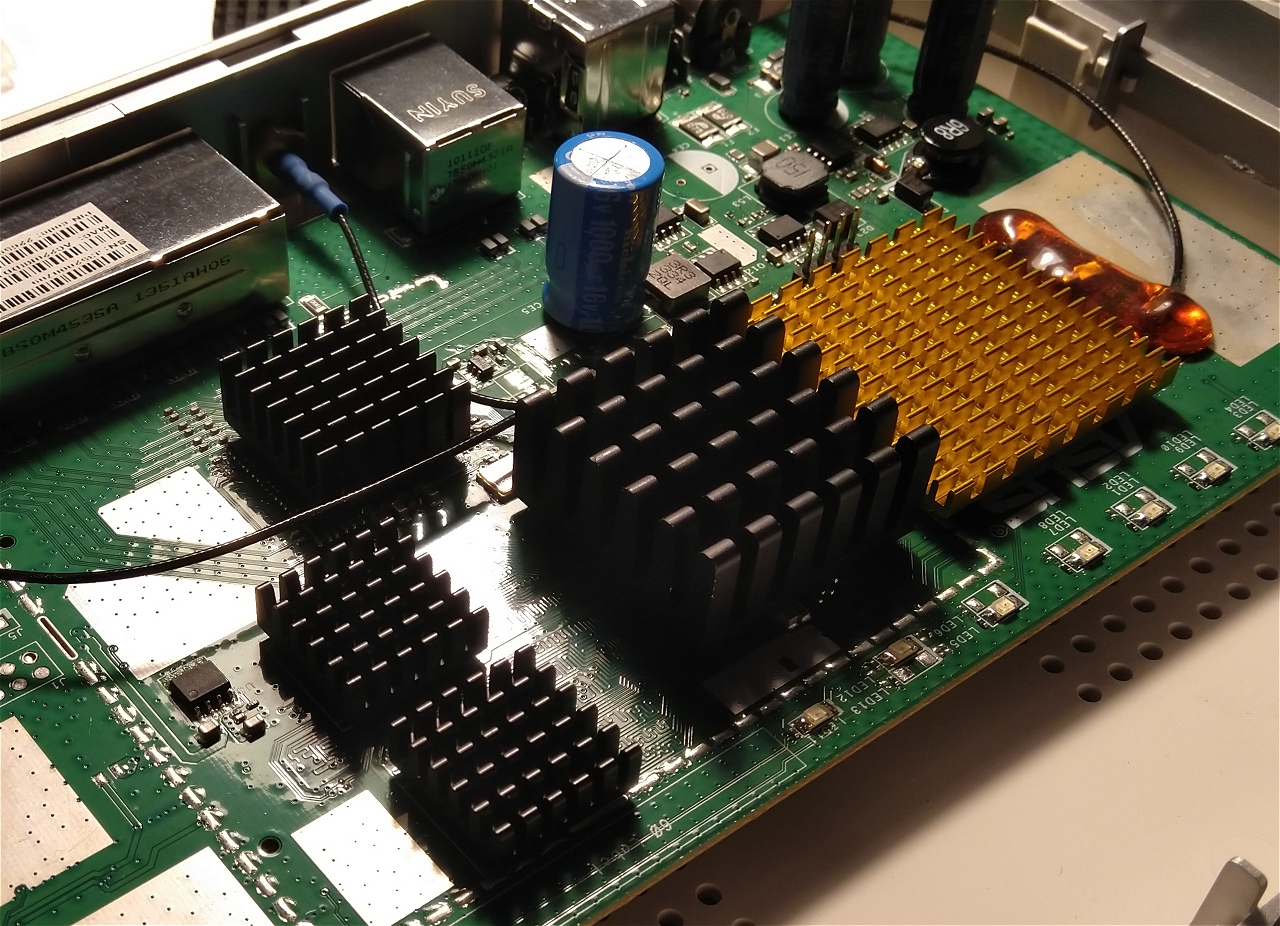
The amount of heat generated is the same. But these new heat sinks should do a better job dissipating it in the air. The router should last longer now. I think that a small fan would be great. The smallest Noctua fan is NF-A4x10, which would fit the case without further modifications. However, for now, I am not sure that I want to invest more time in this project.
As of 2023, I still think this is a good router albeit plagued by cost-cutting decisions. I still use it, and hope to do so in the coming years.
Your Help Matters
This content is provided as-is and is not for commercial purposes. It reflects my experiments and research and should be treated as such. I release my work to the public for educational purposes. I did all this at my own expense and in my free time. So if you like my work, or find it useful or inspiring for your projects, please consider making a donation.
Copyright © 2004- Alexandru Groza
All rights reserved.
VER. 1.0 | REV. A